Tuesday, 25 October 2016

4. Exploring Southern Kyoto

When I'm left in my own company, I feel like I should be constantly productive - learning Japanese, sending emails, sorting through the many many complications that come with living abroad. If I don't do these, then I get so angry with myself for wasting time and not making the most of the year; it gets pretty exhausting when you forget how to enjoy being alone. After a couple of weeks of this building up, I decided to have a day free from studying and other duties to explore Kyoto by myself. It may not have ended up the relaxing experience I intended, but it was a really great adventure anyway ^_^

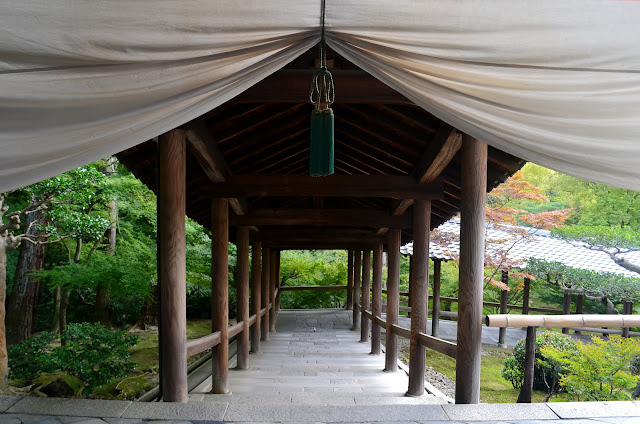
I decided to head to a temple in Higashiyama-ku called Tōfuku-ji - one of the Five Great Zen Temples in Kyoto (the Kyoto Gozan). As with all the big temples in Kyoto, whole days could be spent taking in all the different sections and details. Unfortunately, most temples close around 4.30pm and I was coming after class so the whole day was not an option for me. I only had time to see the Northern area of the temple grounds, which included Tsutenkyo Bridge and Kaizando Hall. Since I was so late in the day it was fairly quiet, and I spend a nice hour or so wandering round pretending I was in a Studio Ghibli film:


I really loved the layout of Kaizando Hall, which you can see in the photos. They split the garden into two distinctive halves - one side is covered with lush green shrubs and the other side is that very simple dry landscape garden (white gravel raked to symbolise ripples in water). It creates a sense of harmony, or at least that's the vibe I was getting. Tsutenkyo bridge, which you can see in the last photo, is a very famous viewing point for the maple leaves in Autumn. They were only just starting to turn when I visited but it was still quite amazing.

Once Tōfuku-ji had closed, I headed about 5 minutes south to a very small and inconspicuous sub-temple called Kōmyō-in which I would never have found without the recommendation of a friend. Unfortunately this had also closed by the time I arrived, but they had left the side door open... it's nice that they don't need to bother locking doors since trespassing in Japan is so unlikely, but since I'd gone all that way I thought I'd take a *peek* into the garden. I hope I didn't offend the Gods there and I made a little offering so they would forgive my curiosity <3


This was the lovely view. Next time, when I'm less afraid of being shouted at in angry Japanese, I will get a much better look at the zen garden and see inside the building. Since it's so hidden away I think it'd be much more peaceful than some of the famous ones like Ryōan-ji.

So after that I was about ready to head home, but Fushimi-Inari was only about 15 minutes walk away and the taiyaki (fish-shaped filled pancakes) stand there was calling my name so I thought I'd made a quick visit...


Fushimi-Inari Taisha, a shrine consisting of thousands of Torii gates, is one of the most iconic places in Japan. I'll probably do a whole post about it at some point, but because of it's popularity it is quite unbearably busy even late in the day. To escape the mass of people walking through the gates, I took a mysterious side route through a bamboo forest. After about 30 minutes it started getting dark, but I had gone so far that I wanted to see what was at the end of the path. I found out far too late that actually I had chosen an alternative route to the top of Mountain Inari, which took me about 2 hours to reach the peak of. About 3/4 of the way up, in total darkness and with a bag full of school-stuff and heeled boots on, I had a serious think about my existence and a little cry. Not quite the quick detour I had planned for.

The peak of the mountain is actually quite underwhelming - the view is completely obscured by trees and it's just another shrine, which by that point you've seen thousands of. Feeling accomplished but a little bit pissed off I began my descent on the normal route and was finally met with the most beautiful view of Kyoto city by night. It was so late that only me and a few other stragglers were there, and because it was so unexpected it was a really magical thing to see. As usual, my poor camera skills haven't done it ANY justice but here's an idea:


After another long climb back down I was seriously ready for a good sleep. This has probably been one of my favourite days in Kyoto so far, and it was so great to be reminded that my own company is enough sometimes. Hopefully there will be many more adventures like this to come :))

Sunday, 2 October 2016

3. Heian Shrine

This day started in a pretty bad way. First, there was the language test that the university insisted I attended despite knowing that I didn't speak any Japanese... which they then sent anyone who didn't know any Japanese straight out of. That was followed by a welcome orientation conducted almost entirely in... Japanese. I'm really wishing that I had worked harder to learn the language before I came out here - everyone else seems to be miles ahead of me and I do feel quite out of my depth at the moment - but on the plus side I'm super motivated to work as hard as I can now.

We then spent a while in Kyoto trying to sort out my friends student Visa. This should have been a fairly straight forward process, but as we were quickly learning, there doesn't seem to be such thing as a straight forward process here. I was feeling quite dejected by this point, but my friends (who are luckily 1000x more knowledgeable about Kyoto than me) knew of a great shrine nearby and we headed there to end the day on a much happier note.


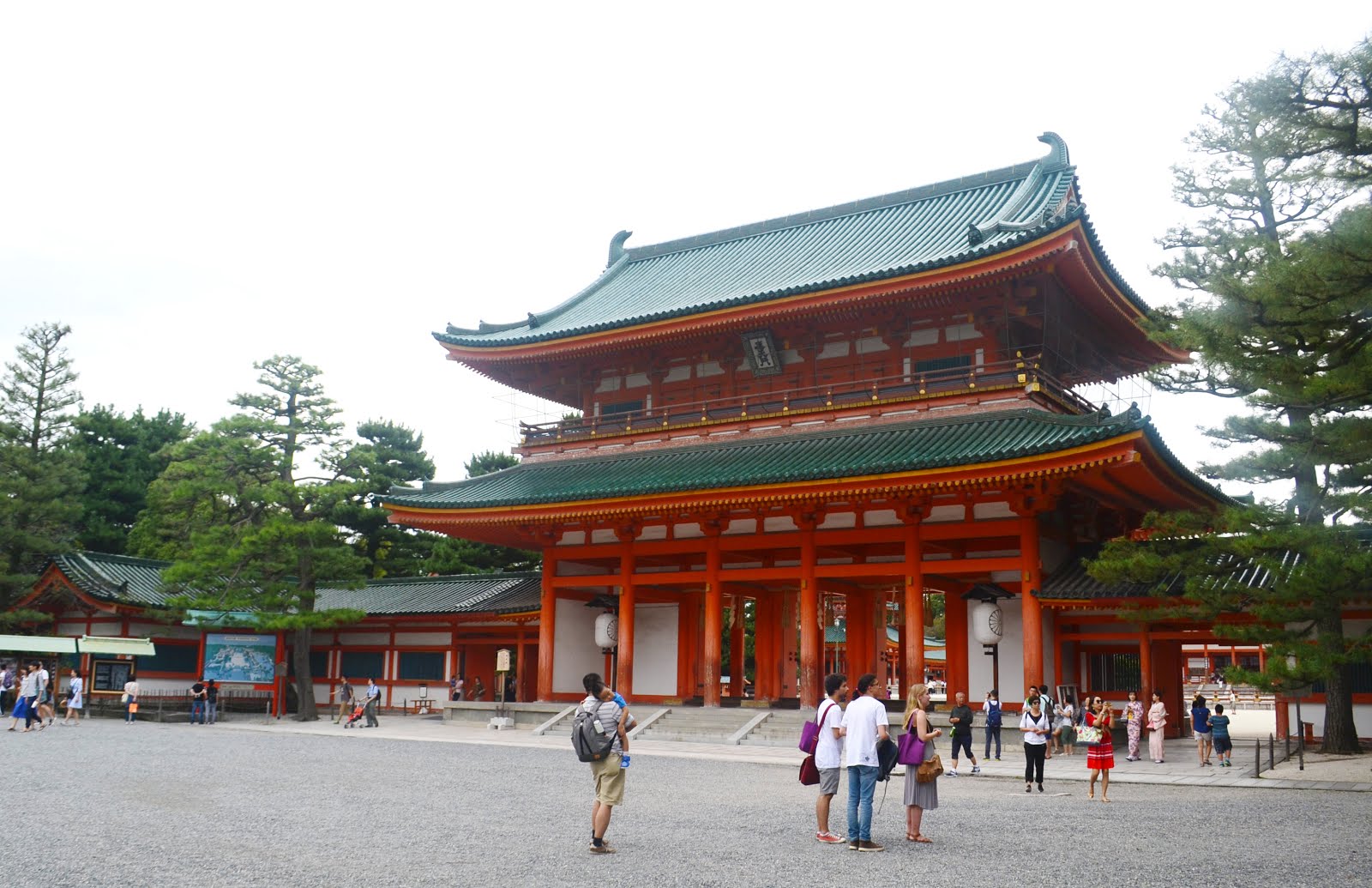
This is Heian Shrine (平安神宮). It was build in 1895 - very recent for Japanese history. Less than 30 years earlier, the capital had moved from Kyoto to Tokyo, and the people of Kyoto were very anxious about the city losing its importance in Japan. Projects like this were part of the 'Kyoto Revival' to help reinforce its status and signify a new, equally prosperous era for the city. Temples like Heian Shrine aren't just single buildings, they are entire... complexes. So much thought clearly goes into the placement of all the structures/gardens and you could easily spend a whole day wandering round finding new things. That photo of the water with leaning cups is a temizuya, they have them at every shrine and you use the cups to wash your hands/mouth to purify yourself before approaching. Aside from being a religious ritual, it's also super refreshing in Japanese humidity. Anyway, after looking at the buildings we paid 600yen to enter the gardens. This was my favourite part BY FAR:


These gardens really were amazing. I would walk through one section with a particular style (for example the first area was very dense, green and mossy), think I had finished the whole thing then come across a huge new section with a completely different aesthetic. It was like walking through a maze. At the end, we sat on the bridge which you can see in one of the photos overlooking a huge lake and spent a long time watching the koi fish and turtles swimming around. I'm really glad that I was with friends who seemed as happy as me to go round at a slow pace rather than getting bored and rushing through it. By the time we were out it was closing time, and I was feeling much more chilled than I had been a few hours earlier :p I'd like to visit again in Autumn when all the leaves are turning, and apparently Heian Shrine is also one of the best places in Kyoto for cherry blossom viewing in Spring. Although having said that, what I loved about visiting on this day was the quietness and stillness of it - something I don't think I'll experience again in the peak seasons.

I'm 3 weeks into life in Japan and there still seems to be no end to the problems we are having to deal with to get settled here. But despite everything that Japan is lacking, places like this make it so worth all the hassle! 

Tuesday, 27 September 2016

2. Day Trip to Nara

Nara lies about an hour South of Kyoto by train, and was the capital city of Japan from 710-794AD. Because of its historical significance, and because it's a lot smaller and more manageable than Kyoto or Osaka, it makes for a perfect day trip. When I decided that I wanted to visit Nara I actually had no idea about any of its history or important sites. It had been at the top of my to-do list for a long long time for another reason....


Nara also happens to be home to over 1200 wild (but very friendly and very very greedy) sika deer. They are free to roam about the park, the streets and even in some of the temples - we stumbled upon a little musical festival going on and it was very surreal to see wild deer casually weaving through the crowd. You can buy special "deer cookies" from street vendors to feed them; I chose to visit Nara on my birthday which meant I had an excuse to buy about 50 cookies and spend a long time running around with excitement. I absolutely loved this bit of the day, it felt really special to be able to get so close to a wild animal without the animal being trapped or forced into it (just coerced with a lot of food...). Deers are considered sacred messengers in Shintō belief, and today they have 'national treasure' status in Nara. You can tell that some of the shop owners don't consider the ones wandering into their shops a treasure, but all in all I think the animals have a pretty sweet deal here.

The deer are also known for being able to "bow" back to a human when they want food, so that provided a lot of entertainment. I did Google afterwards and apparently the bowing motion is normally to assert dominance or prepare to headbutt.. I'm not sure whether this is what the deer in Nara were saying or if they've just learnt how to please us silly humans to get what they want. Either way, it was really lovely and exactly how I wanted to spend my 21st.


After walking through the park for a while we found Tōdai-ji temple, which is famous for housing an absolutely HUGE statue of the Buddha (Daibutsu/大仏殿). Apparently it's 15 metres tall and weighs around 500 tonnes. I wish I had a photo which could do any sort of of justice to this incredible statue but it really is something that you have to see in person to appreciate. Even though I'm not religious, I still get that strong sense of *I don't quite know what* when I'm at a really impressive religious site and I can totally understand why something like this would have meant/still means so much to people. Inside the building, one of the pillars has a hole in it which is only just big enough for a human to crawl through. It looked terrifying and claustrophobic so I didn't do it, but apparently it's 'exactly the same size as one of the Great Buddha's nostrils' and if you can crawl through then you're guaranteed enlightenment (...), so I guess I'll have to go back!  

Anyway, Tōdai-ji itself was absolutely gorgeous. I like the little gold horns on top of the main building, which are a very Chinese influence. I particularly loved the statue of Binzuru Sonja which sat outside - if you have an illness or injury then the custom is to rub that part of his body and then your own for healing. He wears a red raincoat and I can't find out why online... I assume to protect him from the wind and rain? Either way, it gives him a lot of character.


Going to Tōdai-ji has made me really want to learn more about religion in Japan. There are so many little details in all the temples and shrines that I wish I understood and knew the background behind so that I could fully appreciate them. Hopefully I'll get to do at least one module about it this term and can go a bit more into depth about some of the things I'm seeing. There were a few more bits that we got up to on my birthday, but rather than rambling for too long I think I'll just leave with this photo of the amaaaazing ramen we ate for dinner:

Saturday, 17 September 2016

1. Arriving in Japan


So for any of you that don't already know (unlikely, since I've talked about little else for the past few months), I've just moved to Japan for the year to study at Doshisha University in Kyoto. As someone who has never been outside of Europe, can't speak the language and has no experience of the country other than what I've seen on TV, it's pretty damn weird and terrifying. But it's also beautiful and exciting and exactly where I've wanted to be for a long time now. It's been almost a week and my phone is already full of notes about things to tell people back home, so I figured a blog was a good way to keep anyone who's interested up to date on what's happening over here.

Since I've spent most of my time so far settling in and getting registered everywhere, I thought I'd start with some bits of everyday life here that I've found interesting.

1. The wildlife. Both good and bad. I've seen huge butterflies and dragonflies, koi fish, turtles, a Shiba inu and very importantly lots and lots of deer <3 However there's also the mosquitoes, the huge spiders on every single corner, SNAKES and the Japanese hornets (Google them and you'll understand why that is so terrifying).

2. The STAIRS. Oh the stairs. Being used to England, where escalators are abundant and disabled access is rightfully an important issue, I actually feel like a hero every time I make it to the top by foot. The stations are killer and I live on the 5th floor of my building, which of course has no lift.

3. The clothing. I absolutely love how most Japanese people here dress, it's so elegant and pretty. But I didn't realise before coming that as a general rule Japanese girls don't expose their shoulders, and don't wear any tops that would even remotely suggest you had a bust. I am very conscious of standing out on the trains at 5"8 and wearing a strappy top because I can't handle the humidity. Also, I spent the first week wearing t-shirts with leggings until someone pointed out that they are considered underwear rather than trousers here. Very glad I didn't spend a whole year doing that.

4. The food prices. Eating out is so cheap here!!! I had the best ramen of my life the other day and it only cost 700 yen, about a fiver. The downside is that supermarkets are really expensive, especially fruit and veg, but I guess that's just an excuse to eat out more.

5. The weird mix of old and new. You can see it physically - there are huge grey office buildings and wiring everywhere, but they're littered with shrines and temples and rice fields and old wooden houses. It's a really amazing contrast. Japan so far also seems to be a mix of super efficient/modern in some ways and SO DISORGANISED in others, but more on that another time.

6. The cars. This is kind of random, but I didn't realise that they drive different cars here and every day I'm so confused and entertained by it. Most people drive something called a Kei car, which I think uses space more efficiently (very Japan) and somehow has basically... no bonnet. Here's what they look like:


I'm still trying to get my head around the fact that I actually live here, it's the craziest weirdest thing and I don't think it's quite settled in yet. But I'm super excited to explore more of the city and meet some more people. Hopefully I'll manage to succeed in keeping this updated with anything new and exciting :)